School events are the ultimate trial for a rental father.
Everyday "father duties" — playing in the park, eating together, celebrating birthdays — take place in closed spaces. It's just the family's world. No third-party eyes.
But school events are different. Teachers are there. Other parents are there. Community members are there. You must perform as "father" in front of a crowd.
And if you're found out, everything is over.
Sports Day — The Biggest Stage
Sports day is the most nerve-wracking event of the year for a rental father.
7 a.m. I arrive at the school gate. Carrying a ground sheet for saving seats, a video camera, and a packed lunch. Other parents are already lined up, doing the same.
"Good morning." "Looks like it'll be hot today." "What grade is your child in?"
Casual greetings. But every one is a potential landmine. "What do you do for work?" requires an answer that matches the backstory. "Do you live nearby?" requires pretending I know the neighborhood.
At one sports day, the father on the neighboring sheet struck up conversation.
"Say, haven't we met somewhere before?"
My heart jumped. I recognized his face from a sports day at a different school — another "family's" event. Had he noticed me there too? Was this man also a "rental"? No — looking at his child, the family resemblance was clear.
"No, I think this is the first time," I replied with a smile.
"Hmm, maybe you just have one of those faces," he laughed. But I will never forget that instant of fear.
The Loneliness of the Bleachers
The spectator seats at a sports day are a strange place.
Hundreds of parents wait for their child's event. They cheer. They film. They shout "Go for it!"
I shout too. "Go for it!" I film. I cheer with all my heart.
But somewhere inside, I know. I am the only "fake father" here. Among these hundreds of parents, I alone am "not real."
The child wins first place in the race. "Yes!" I shout. The mother beside me says, "Your child is fast!" I reply, "Thanks — he runs every day."
A lie. I don't know if he runs every day. I'm simply giving a plausible answer based on information from the mother.
But the joy I felt when the child crossed the finish line — that was real. That, at least, was no lie.
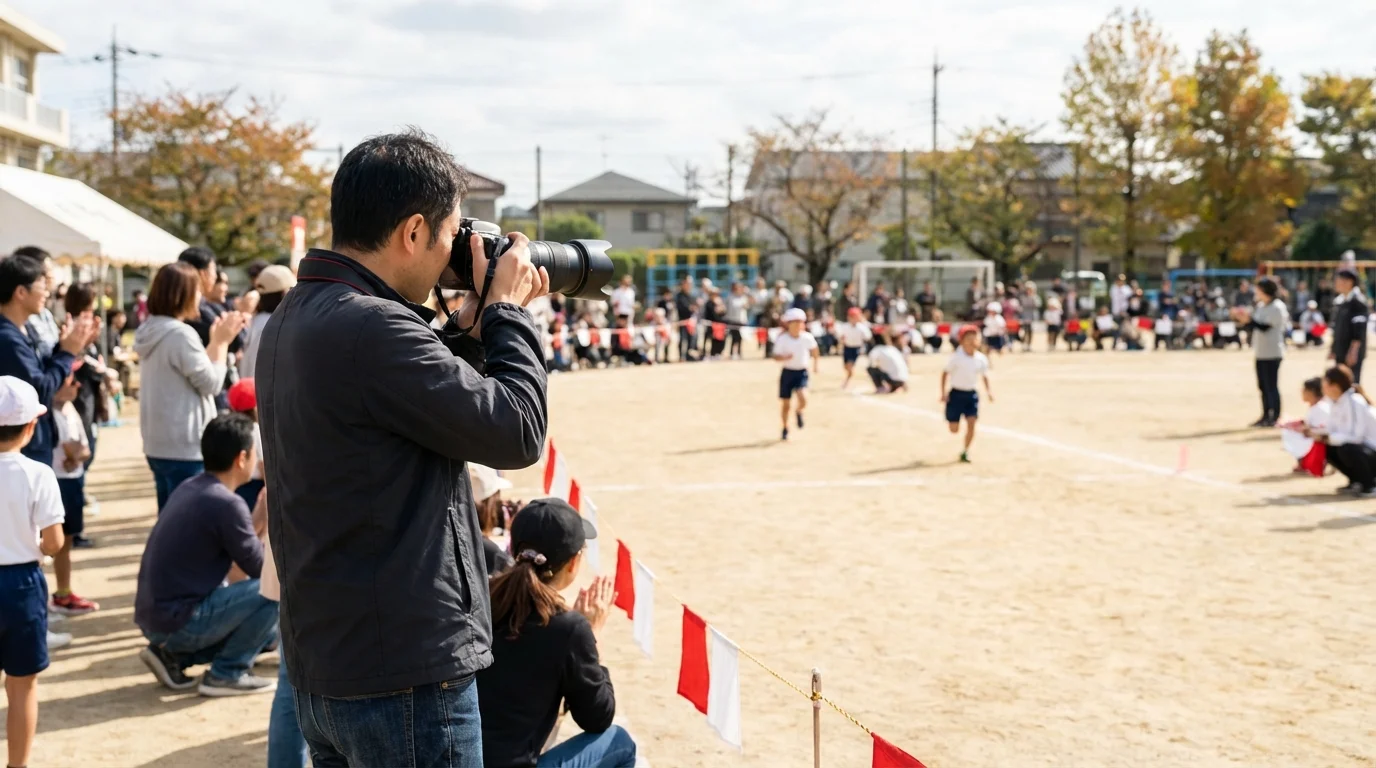
Cheering from the bleachers as the "fake father" among hundreds
Parents' Observation Day — The Closed Room of the Classroom
Parents' observation day carries a different kind of tension from sports day.
The classroom is small. Parents stand close together. Faces are easily seen. Voices carry. And it lasts 45 minutes of standing still.
The child raises a hand and speaks: "My father works overseas" — reading aloud from an essay. Classmates react: "Cool!" The teacher says, "What a wonderful job your father has."
Standing at the back of the classroom, several parents glance my way. The look that says, "So that's the dad." I smile and nod.
After the observation, there's usually a "parents' meeting." Another hurdle.
"It's unusual for a father to attend," the teacher remarks. True — few fathers come to these meetings. Which makes me stand out. And standing out is the last thing a rental father wants.
But sometimes the mother can't attend because of work. Then "Dad" has to step in.
"Please contact me if anything comes up with the child," I say, handing the teacher a business card. The card, of course, is fake. The number forwards to the mother. These details require thorough preparation.
Parent-Teacher Conferences — The Most Dangerous 30 Minutes
Parent-teacher conferences are the most dangerous event for a rental father.
Sitting face-to-face with the teacher. The child beside me. The teacher discusses grades, behavior, and friendships in detail. Then asks for the parent's perspective.
"How is the child at home?"
That question makes me pause for a split second. "At home" — I'm not part of this child's home. I visit once or twice a month. But I must pretend to know what "home" looks like.
Pre-meeting briefings with the mother are my lifeline. Recent behavior at home, study habits, friends' names, worries. I absorb all of it and present it as "my own words" at the meeting.
"He seems to be struggling with math lately. We see it at home too. Do you have any study tips?"
The teacher looks relieved. "I'm glad to see you're paying such close attention at home."
The child sits beside me, listening silently. "Dad knows a lot, huh" — that look pierces my chest. I know because the mother told me. But wanting to know was genuine.
"The 30 minutes of a parent-teacher conference are the most intense 30 minutes of my life. One wrong word could destroy everything. But at the same time, I can see how much the teacher cares about the child. I want to honor that trust."
— Yuichi Ishii
School Plays and Recitals — When Children Shine
School plays and recitals carry a different kind of emotion from sports days.
On stage, children deliver their lines with all their might. They sing. They play instruments. Some tremble with nerves. Some make mistakes and cry.
Once, I attended the school play of a 7-year-old girl. She played a fairy in "Cinderella." Just two lines: "I shall grant your wish" and "Now, off to the ball."
Before the performance, she peeked out from backstage and asked, "Is Daddy here?" When I waved, she smiled with relief.
During the performance, she nailed her lines. Her voice was strong. Afterward, she ran to me in the audience: "Daddy, did I do good?"
"You were amazing," I said.
Other parents complimented her too: "Your daughter was wonderful." "Thank you," I replied, thinking: what it means to this child that "Daddy was watching" — that is immeasurable.
The Battle Against Being Discovered
At school events, the greatest fear is being found out.
There are several patterns of exposure.
First: someone recognizes me. Family Romance's work has been covered by media. It became a movie. There is a non-zero chance someone knows my face.
Second: running into someone connected to another "family." If I serve as father for multiple families in the same area, school zones can overlap. If a PTA president's wife spots me at another school — the thought alone makes me break into a cold sweat.
Third: connections between children. Cram schools, extracurriculars, community sports teams. Children's social circles extend beyond school. "Hey, that's the same dad as before" — if that were said...
My countermeasure: prioritize geographically distant families. No more than one "family" per ward. It means more commuting time, but it's essential for risk management.
Even so, 100% safety is impossible. The tension is constant.
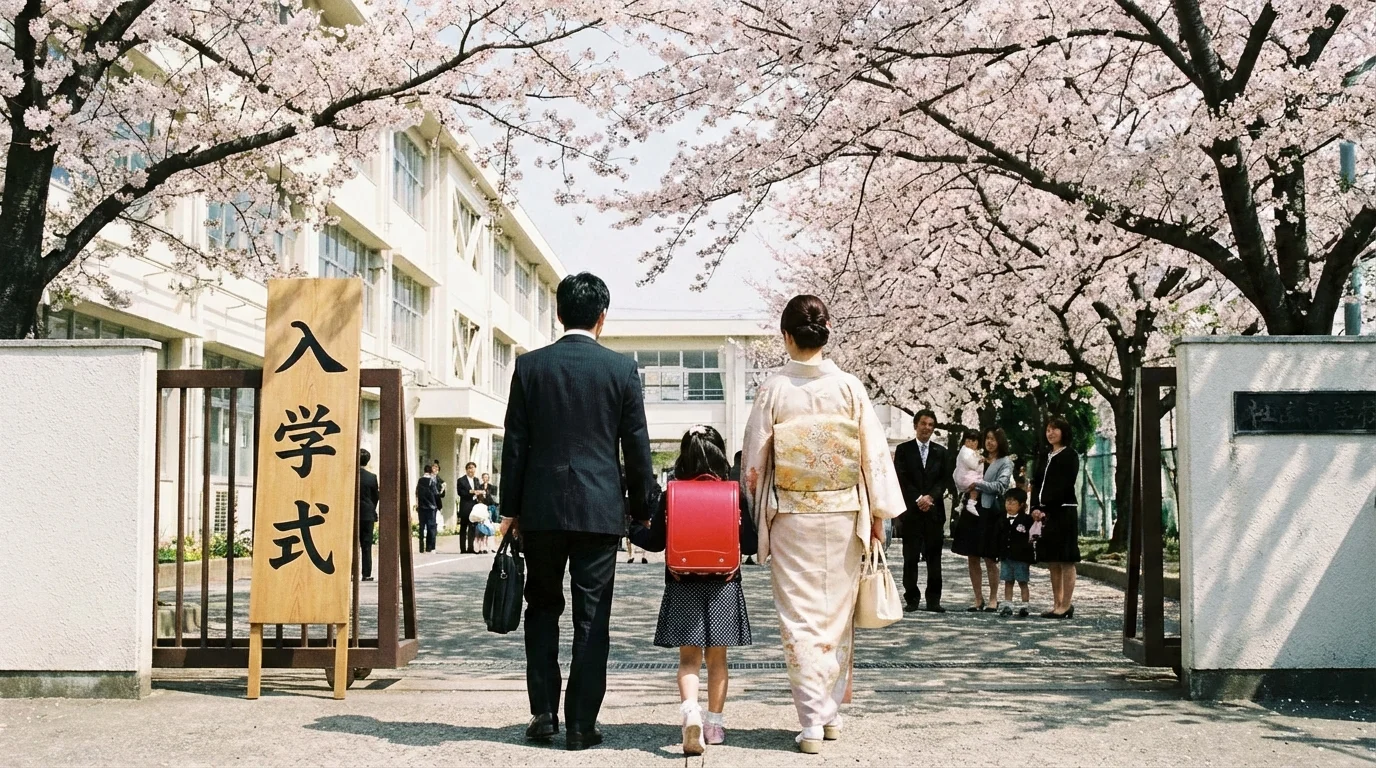
Every school event demands meticulous care to avoid detection
Father's Day Projects — Gifts from the Classroom
The third Sunday of June. Father's Day.
Schools hold craft activities for the occasion. "A letter to Dad." "A portrait of Dad." "A present for Dad."
For single-mother households, this event is cruel. A child without a father has no one to write the letter to. No one to draw.
But children with a rental father don't hesitate. They draw "Daddy's" portrait. They write "Dear Daddy."
Every year, I receive Father's Day gifts from multiple children. Handmade keychains. Clay pen holders. Origami bouquets. Cards that read, "Thank you, Daddy."
I keep every single one.
One year, a 9-year-old boy's letter read:
"Dear Daddy. You're always busy and we can't see each other much, but when we do it's really fun. I'm glad you're my daddy. Thank you for being my daddy."
When I read that letter, I wept out loud. "Thank you for being my daddy" — I will carry the weight of those words for the rest of my life.
Keeping the Right Distance from Other Parents
At school events, the most important thing is maintaining the right distance from other parents.
Too close, and the risk of probing questions rises. Too distant, and people start whispering: "That family's father is odd." A moderate distance is essential.
The ideal position: "A pleasant but somewhat quiet father." I greet people. I make small talk. But I never let anyone into my personal space. "Work keeps me busy" is the universal excuse.
The hardest situation is being invited out for drinks. A fathers' gathering. Declining every time looks unnatural, so I attend roughly once a year.
Over drinks, tongues loosen. Other fathers share work complaints, marital troubles, child-rearing struggles. I need to contribute something too.
"My kid is going through a rebellious phase too" — safe, generic topics. I avoid specific anecdotes. If pressed deeper: "Excuse me, bathroom break."
A nerve-wracking evening. But surviving these moments solidifies my presence as "that family's dad."
"School events mean performing as a father 'outside' the home. Inside the house, a slip can be corrected. But at school, dozens of eyes watch me. A single mistake can lead to irreversible consequences."
— Yuichi Ishii
Photographs as Evidence
School events produce a massive number of photographs.
Group photos, candid shots, commemorative photos. Many parents snap away on smartphones. Some post them on social media.
To me, a photograph is "evidence." Evidence that I was there. Evidence that could expose my presence as "father" at multiple schools.
So I avoid being photographed whenever possible. In group shots, I stand at the edge. During candid moments, I naturally turn my face away. "I'm camera shy," I say with a laugh.
But photos with the child are different. When a child says "I want a picture with Daddy!" I can't refuse. That photo is the child's "memory with Dad." The child's memory matters more than my risk.
As a result, multiple households possess "father and child" photos. In every one, the "father" is the same person. Someday that could come to light. But I choose the child's smile.
Conclusion — School as a Microcosm of Society
Every time I attend a school event, I think:
School is a microcosm of Japanese society. The "two-parent household" is the default, and families that deviate feel the pressure. Fathers' days, mothers' days, family photos — everything is designed around the "normal family."
Without a rental father, the child eats lunch alone at sports day. Looks at an empty back wall during parents' observation. Freezes in front of a blank sheet on Father's Day.
With me there, the child gets to be "normal." Whether that's right or wrong, I don't know. Perhaps the very demand for "normalcy" is the problem.
But the child in front of me is smiling. Beaming because "Daddy came." For that smile, I walk through the school gates today.
With nerves. Praying not to be found out. And yet, for the child's smile.
"School events are a trial. But as long as a child says
— Yuichi Ishii
'Daddy, come!' with a smile, I will keep standing there."